Free Resources / Quick QA Checklist Free Estimating Resource · 2026 Edition

The Quick QA Checklist for High-Risk Bid Areas

Most bad bids don't fail because the estimator didn't know the job. They fail because one small thing got missed on a busy day — an old drawing, a rounded-off number, a missing bond form. This is a short pass you run right before you hit submit, so those small things get caught in time.
13 quick checks 20–30 min to run per bid Print it, run it, done
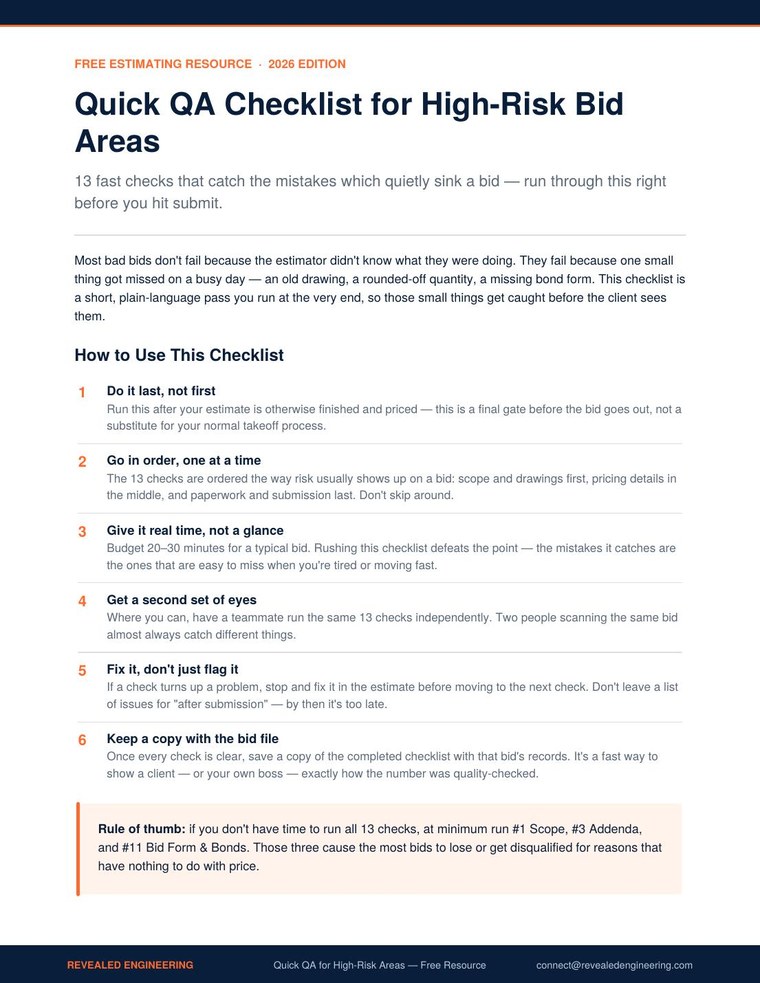
Page 1 of 3 Preview of the Quick QA Checklist for High-Risk Areas document
What you'll get — 3-page PDF, free to download

This is a straightforward checklist. You run it once, right before a bid goes out the door, to catch the small mistakes that cause big problems — a missing bond form, an old drawing, a rounded-off number. Nothing here requires special software or training.

What This Checklist Is For

Think of it like a pilot's pre-flight check. The estimate itself is already built — the takeoff is done, the pricing is in, the sub quotes are in hand. This checklist is the last look before it goes out, to make sure nothing small got missed along the way. It's not a replacement for your normal estimating process. It's a safety net for the end of it.

13
simple checks, start to finish
20–30 min
typical time to run it
1
final pass, right before submission
$0
cost to use

How to Use This Checklist

1
Run it last, not first
Use this once your estimate is basically done and priced. It's a final gate, not a replacement for your takeoff.
2
Go in order, top to bottom
The 13 checks are arranged the way problems usually show up — scope and drawings first, pricing details in the middle, paperwork and submission last.
3
Give it real time
Budget 20–30 minutes per bid. Rushing defeats the point — these are exactly the mistakes that slip through when you're moving fast.
4
Get a second set of eyes
Where you can, have a teammate run the same 13 checks on their own. Two people almost always catch different things.
5
Fix it right away — don't just note it
If a check turns up a problem, stop and fix it in the estimate before moving to the next one. Don't save a list of issues for "later."
6
Save a copy with the bid
Once every check is clear, keep the completed checklist with that bid's paperwork. It's an easy way to show how the number was checked.
Rule of thumb: if you're ever short on time, run at least #1 Scope, #3 Addenda, and #11 Bid Form & Bonds. Those three cause the most bids to lose or get disqualified for reasons that have nothing to do with price.

Quick Answers

Is this the same as a full estimate review?+

No. This is a fast, final gate — it catches everyday slips, not the deeper work of building the estimate itself. Keep doing your normal takeoff, pricing, and review process. Run this checklist as the very last step.

How long should this actually take?+

Most estimators can get through all 13 checks in 20–30 minutes for a typical bid. Bigger or more complex bids may take longer — that's time well spent compared to the cost of a missed item.

Who should run it — the estimator, or someone else?+

Both, ideally. Have the estimator who built the bid run it first, then have a teammate or supervisor run it again independently. A second set of eyes on the same 13 checks tends to catch different things.

Can I change the checklist for my company?+

Yes — this is a starting point. Add a check specific to your trade or region if it keeps coming up as a problem. The goal is a short list your whole team will actually use, every time.

This checklist is a final quality-check step, not a substitute for your own estimating judgment or your company's existing review process. Adapt the wording and the order to how your team actually works.
Free Resource

Get the printable PDF

The full PDF includes the "how to use this" walkthrough and all 13 checks laid out on a clean, printable page you can pin up or keep on a second screen.

Download PDF ↓